
Jordan Crawford is one of the operators I learn the most from in my role as a GTM engineer.
His content is a rare mix of:
Strategy: his thought process, how he frames problems
Tactics: the actual builds, what tools, what stack, how he’s running it
So when he released a video on the Concentric Circle Test for Pre-PMF, I thought that it was worth a deeper look.
Your List is Your Message
You’ve probably heard this said until it’s cliché, but I really do think that this is an effective strategy. In cold outbound, who you put on the list (company + persona) has the biggest impact on campaign performance.
And who ends up on the list depends on WHY you put them there in the first place.
Segment, Company, Persona
This section explains the WHY behind the list by using the framework from Jordan’s video above.
The three layers ask three different questions: who shares the pain (segment), which entities are feeling it acutely right now (company), and which role inside the company gets your email with their pain (persona).
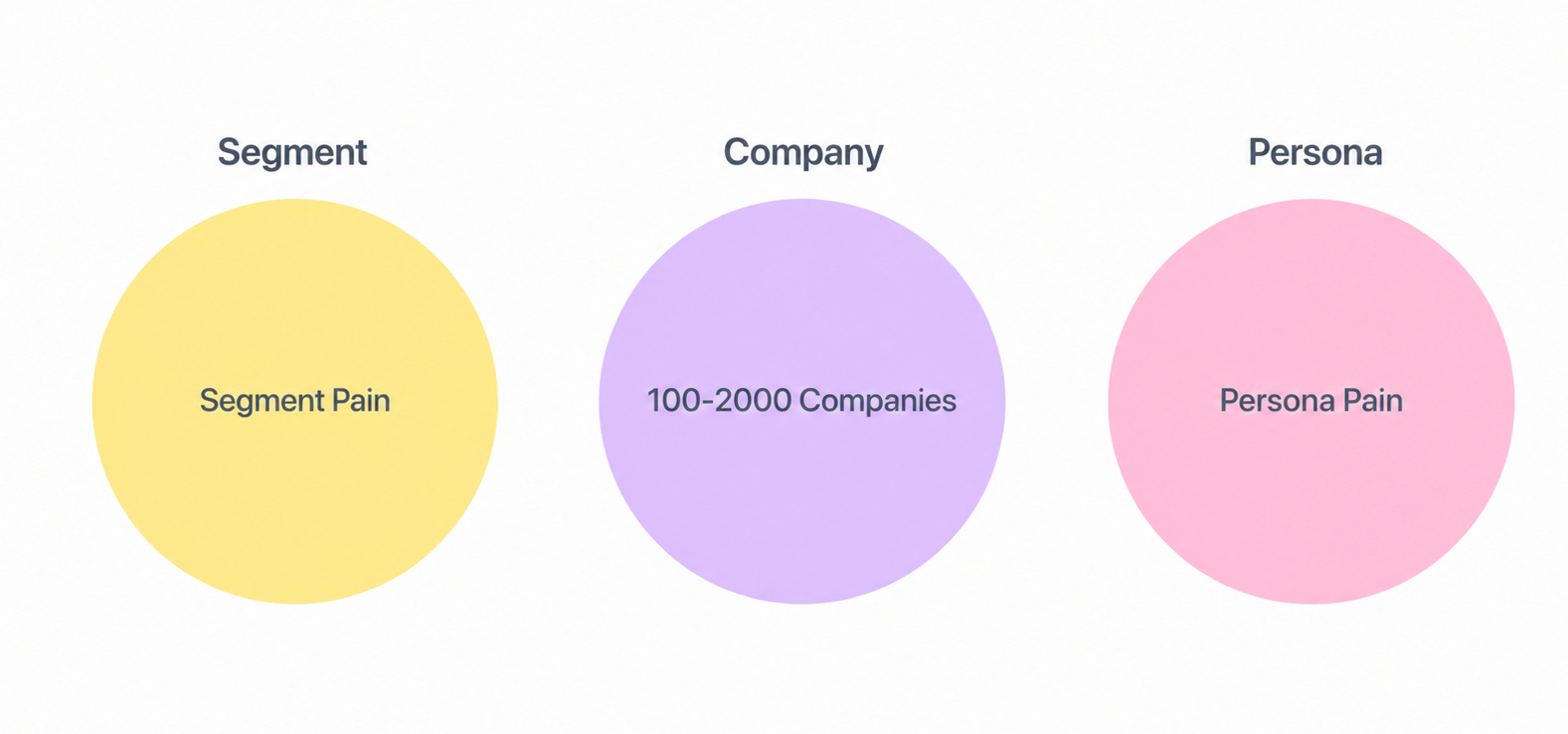
Segment
A segment is a group of companies who share the same #1 pain, and your solution is the answer to that pain.
Company
When your segment is well-defined, the company list is already implied.
This is where I’m using these tools to help to form the company list quickly.
Exa.ai
Ocean.io (for lookalikes)
Sumble
I’d say try to aim for around 500 to 2,000 companies. If the company list is too small, you can’t run an effective outbound campaign.
Persona
Persona is who inside the company you actually message. The same segment-level pain feels different depending on who actually receives your message, so the message has to change.
Simplest example I can think of: boutique fitness studios
Segment: boutique fitness studios
Segment-level pain (shared by every studio): member retention. The monthly membership model breaks if churn rises by 2 to 3% in a quarter, because acquiring a new member costs 5 to 10x more than keeping an existing one.
Persona 1: Studio Owner
Their version of the pain: “If churn spikes this quarter, my margin disappears and I can’t pay the rent on the studio.”
What they care about: keeping the doors open, monthly recurring revenue, the studio surviving.
Persona 2: Head Coach / Senior Trainer
Their version of the pain: “If members stop showing up to my classes, class sizes shrink, my hours get cut, and my salary takes a hit.”
What they care about: class numbers staying full, hours not getting trimmed, being seen as the coach members come for.
So the full hierarchy looks like this:
Segment = pain shape (the WHO that shares it)
Company = which entities are acutely painful right now (the WHEN)
Persona = which role inside the company feels it AND/OR buys against it (the WHOM, and the angle on the pain)
Contextualising the Learnings to My Role at Riverside
My main vertical at Riverside is getting booked B2B demos for our webinar product line.
The approach I typically use is signal-driven. I created automated tools that capture signals daily and feed them into my outreach cadence. The signals I’m watching for include:
Companies that have just posted or registered a new webinar
Companies running webinar-related ads
Companies posting webinars on 3rd party aggregators
& others
The outreach cadence is triggered by what's happening at a company in real time, not by a static list I built six months ago.
Jordan’s approach sits in a different place on the spectrum. His framework isn’t about signals forming the bulk of the outreach but it’s about finding very hyper-targeted companies inside specific sub-segments, where your outreach message resonates immediately because the segment is so well-defined and your solution sits at the centre of their pain.
So I wanted to see what would happen if I applied Jordan’s framework on top of my existing signal-driven approach. The question I was trying to answer: can the framework help me figure out which sub-segments are worth chasing signals in, versus which ones I should deprioritise?
How I Built the Sub-Segment List?
Step 1: Understand the main segments of our webinar product.
Bucket #1 (webinars are part of the business: revenue is structurally tied to webinars happening)
Bucket #2 (webinars are a tactic to drive pipeline, brand, NRR, or channel).
Step 2: Use Claude to generate sub-segments within each bucket, broken down by industry vertical.
The intention here is to use AI for the heavy lifting on the research work. Claude can find, compress, and analyse data at scale, which is exactly what this stage needs.
The output was 132 sub-segments, split roughly evenly between the two buckets.
Step 3: Use Apify SERP scraper actor to complement Claude’s output.
The intention to provide additional verification sources for what Claude generated.
Also, this helps to surface long-tail sub-segments Claude might have missed, like accredited CE provider registries, professional association directories, or cohort course catalogs.
The combination of Claude’s reasoning plus Apify’s web-scraping coverage gives a much fuller picture than either alone.
Step 4: Validate each sub-segment with Discolike.
For each sub-segment, I pulled 10 sample companies and ran them through the Discolike database to check whether at least 50% returned a webinar-related keyword hit.
Sub-segments that passed went into the final list.
Results
Bucket #1: Webinars Are Part of the Business
Their revenue is structurally tied to webinars happening. I’ve added 10 of them just as a reference.
B2B webinar / town-hall production agencies
Multi-day virtual conference production agencies
Hybrid event production agencies
Podcast-to-video production firms
Sponsored-webinar B2B trade publishers
Independent analyst firms w/ subscription webinars
Paid newsletter operators w/ sponsored webinars
Year-round virtual conference operators
Premium cohort course platforms
Solo cohort instructors / paid Substack workshops
Bucket #2: Webinars Are a Tactic
Their revenue is tied to pipeline / brand / talent / NRR / channel. Webinars are one of ten levers to drive it.
B2B SaaS demand-gen webinars (master)
Developer-led SaaS / DevTools / AI infra
Management consulting / strategy firms TL webinars
Big 4 audit / tax firms insight webinars
BigLaw / mid-market client-education webinars
Investment banks market-outlook webinars
PE firms LP-relations webinars
Asset managers advisor-distribution webinars
Wealth management firms client retention webinars
Marketing / PR / branding agencies thought leadership webinars
Learnings + Thoughts
The biggest unlock from applying Jordan’s framework was Bucket #1.
Looking at the sub-segments inside Bucket #1, a lot of these are companies running webinars behind closed ecosystems. Things like paid cohorts, premium masterminds, sponsored publisher events, and accredited CE programs that operate behind paywalls or login walls. My signal-based workflows are tuned to catch public-facing signals (new webinar landing pages, registration flows, ad spend, hiring), and these closed-ecosystem companies don’t surface there.
So Bucket #1 opened up a whole new TAM that I wouldn’t have reached through signals alone. I’d say that’s a real unlock in terms of strategy, process, and campaign mapping.
For Bucket #2, I’m 90% confident my existing signal-based workflows are already picking up most of these sub-segments. They’re companies running visible demand-gen webinars (B2B SaaS, consultancies, PE firms, agencies) where signals like new landing pages, registration flows, and ad spend fire consistently. They should already be part of my existing campaign capture.
I think the takeaway is that effective outbound needs both. A segment-driven approach (like Jordan’s) finds the companies your signals can’t reach because they operate behind closed walls. A signal-driven approach catches the ones publicly broadcasting their intent in real time.
They capture very different slices of TAM, and ignoring either approach means missing whole pockets of the market.