
There’s a lot of ambiguity (and hype) around the GTM engineering role recently. You have probably saw plenty of LinkedIn posts in 2026 from companies hiring for GTM engineers.
But what does a GTM engineer actually do?
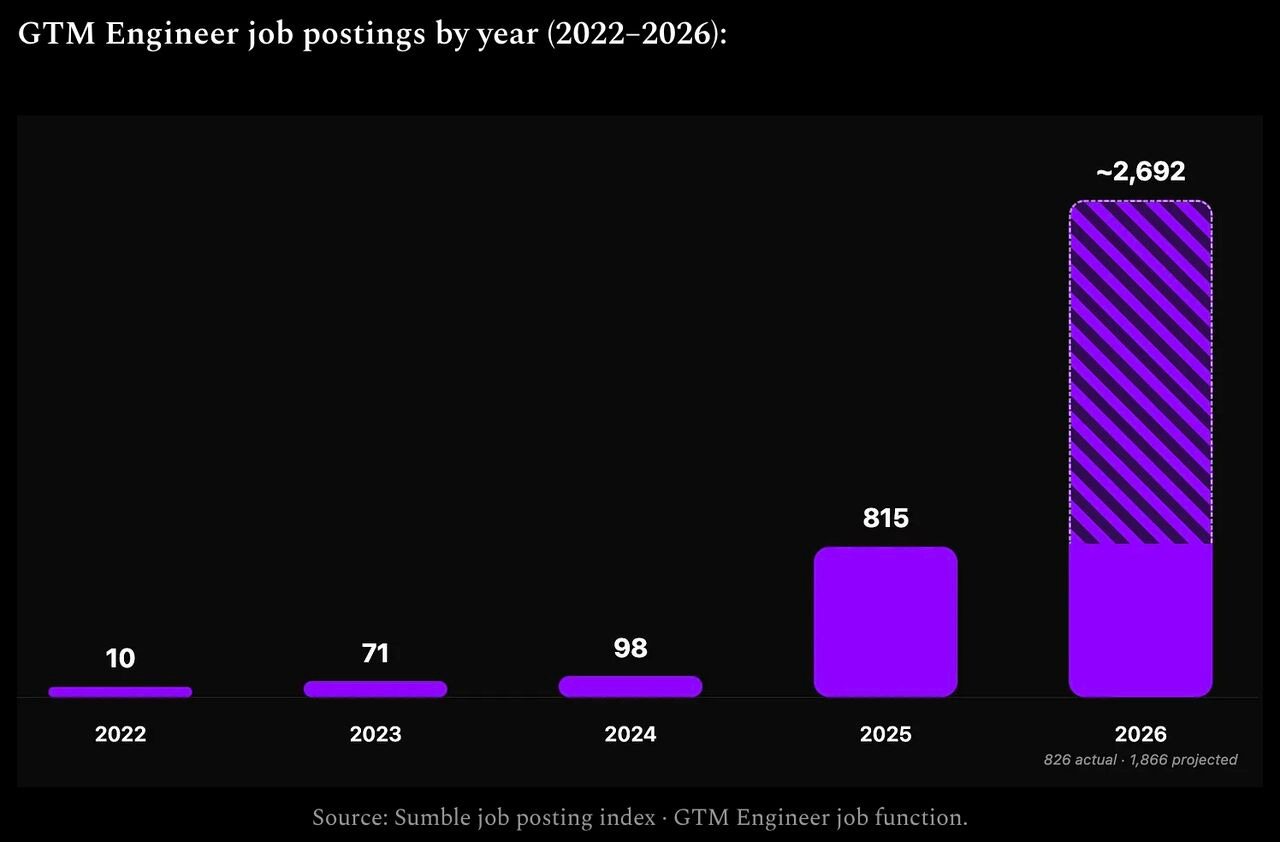
I think the best way to answer this is to strip away all the technical and tactical competencies a GTM engineer is supposed to have, and go straight to the business impact they’re hired to deliver.
For 99% of GTM engineers out there, the role only exists in sales-driven B2B organizations, IE companies selling to other companies, not consumers.
And inside those companies, the role tends to live in one of two places: under Marketing, or under RevOps. In my opinion, where it sits changes what the job actually is.
From my observation, this split is most obvious in larger organizations where there's a standalone RevOps department. The GTM engineer role gets kinda blurry in smaller companies where there's usually no dedicated RevOps team, or even a single RevOps hire.
In those companies, you'll see one GTM engineer wearing both hats: handling the marketing and the revenue operations tasks at the same time.
GTM Engineer (Marketing) VS GTM Engineer (RevOps)
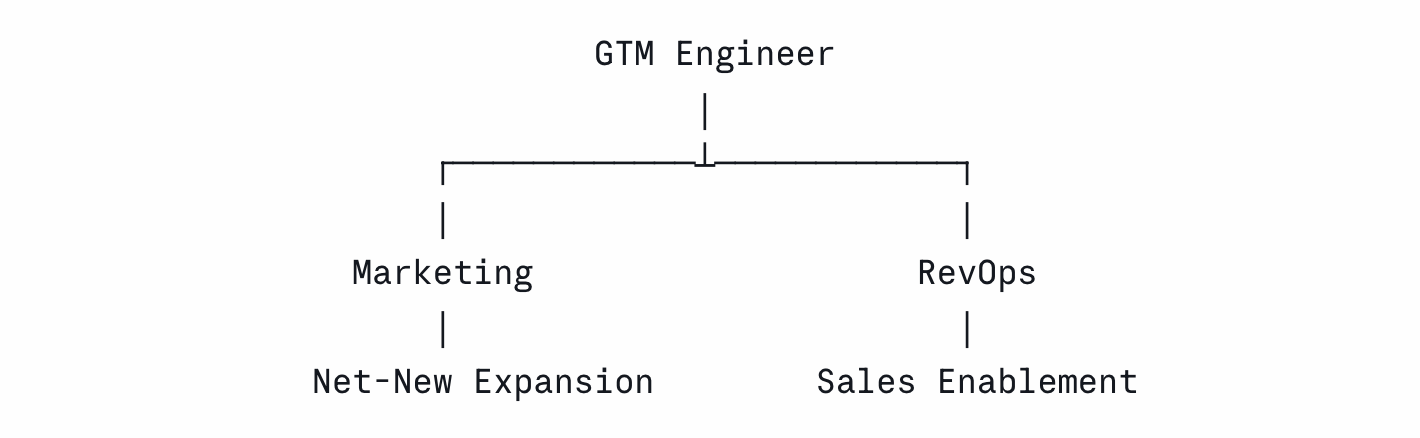
There’s 2 types of GTM engineers.
GTM Engineer (Marketing)
Attached to the marketing department
Sits inside the marketing department
Main goal: to drive net-new market expansion, bringing more new customers into the SLG pipeline
Owns the systems that generate, qualify, and route demand at the top of the funnel
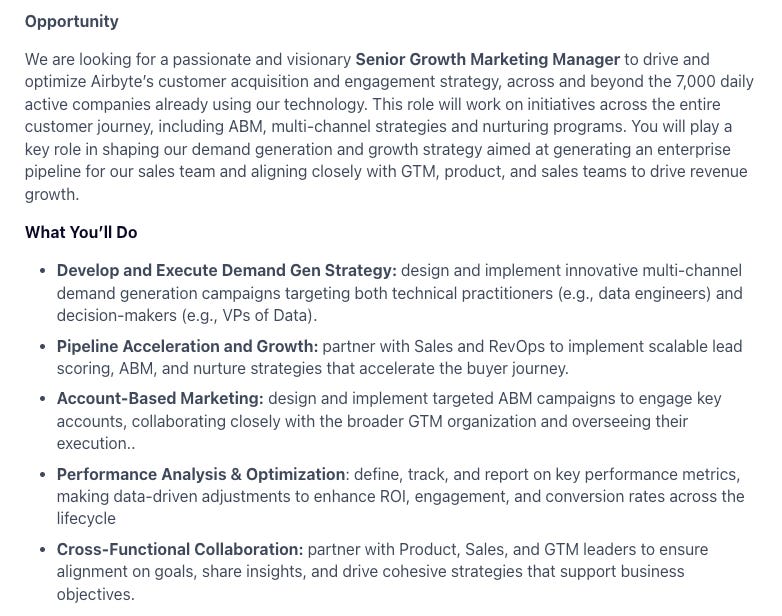
GTM Engineer (RevOps)
Sits inside the revenue operations department
Main goal: to drive sales enablement, making the existing sales motion faster and more efficient
Two main levers they work on:
Sales velocity → how to move deals through the pipeline faster
Conversion → how to turn more leads into closed-won, faster
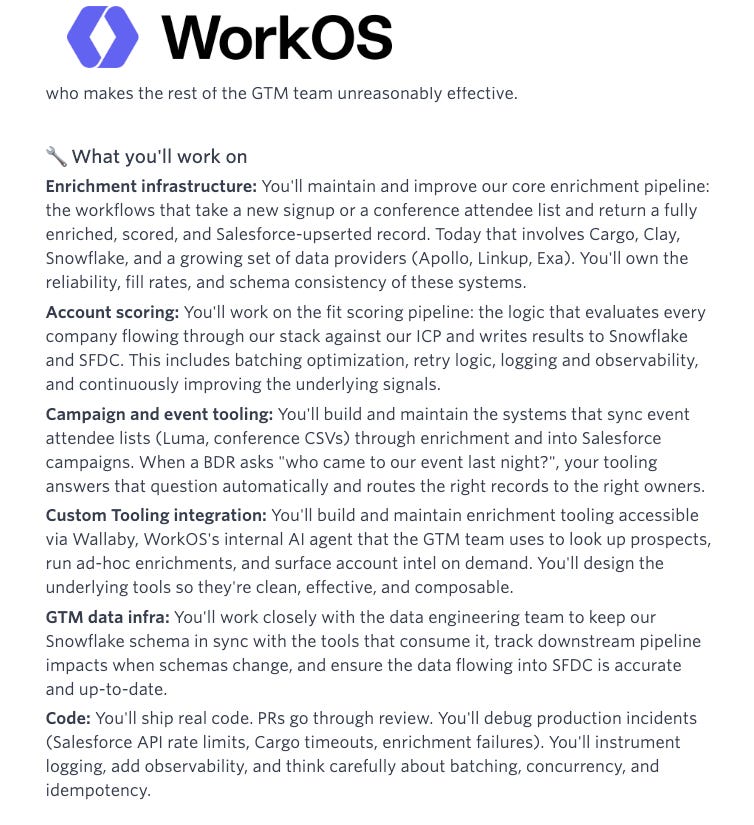
Use Cases: GTM Engineer (Marketing)
Outbound
This is probably the most common use case of a GTM engineer in Marketing. These roles were pioneered (I think) in companies like Ramp, Gong, and Rippling, where outbound forms a huge % of their net-new pipeline.
The core essence of cold outreach is to use different channels (email, LinkedIn, etc.) to reach net-new accounts that aren’t in your CRM yet. The intention is to turn a cold prospect into a booked-demo opportunity.
Where the GTM engineer comes in is building the tools that help find, qualify, and reach the right accounts at scale:
Signal-based prospect sourcing by building prospect + company lists from real-time triggers like job changes, funding rounds, hiring activity, podcast or webinar launches, and tech stack adoption. For example, outreaching to a SaaS company that just launched a weekly webinar series.
AI-powered personalization at scale by using LLMs to generate first-line openers, custom value props, or full email bodies based on the prospect’s recent activity (a podcast episode, a job posting, a LinkedIn post).
Multi-channel orchestration (increasingly important) sequencing email + LinkedIn across tools like Instantly, Smartlead, or HeyReach.
The GTM engineer also owns the deliverability infrastructure underneath such as domain warming, inbox rotation, inbox placement tests, and so on.
PLG Activation & Expansion
This one’s more specific to my work as a GTM Engineer at Riverside. Riverside runs both a PLG motion and an SLG motion - meaning we have self-serve users on our lower-tier plans, and we also have larger B2B customers on our Business plan.
The core essence here is that companies like Riverside, with an existing PLG motion, have an opportunity that pure SLG companies don’t: converting existing paying self-serve customers into Business-plan opportunities. The intention is to catch the moment (via signals) when a current self-serve customer qualifies for that conversation.
Where the GTM engineer comes in is building the system that watches for those signals and routes them to the right place:
External signal monitoring for changes in the company’s world that make a current paying user suitable for an upsell conversation. A self-serve user gets promoted to Head of Marketing. Their company raises a Series B. They start hiring a content team. They launch a podcast or webinar program.
Automatic routing the moment a signal fires. Any of the above can qualify an existing self-serve customer for the Business plan and the GTM engineer builds the system that catches those signals and pushes the account into an outbound sequencer (or to an AE) the moment they fire.
Use Cases: GTM Engineer (RevOps)
AI-Assisted Rep Enablement
The whole idea behind AI-assisted rep enablement is figuring out how to take low-leverage, time-consuming manual work off each BDR or AE’s plate so they can spend more time actually selling. These enablements can range from very simple tools to highly complex ones.
Slack prospect number generator. Historically, finding a prospect's phone number is a manual process. The rep logs into one data provider, then another, then another, hoping one of them has a verified number. With AI, this becomes a single Slack command: the rep pings the bot with a name and company, the request gets pushed into Clay, Clay runs an API waterfall across two or three providers, and the verified number comes back into Slack within seconds.
AI-assisted call prep through auto-generating 1-page account briefs that surface recent company news, the prospect’s LinkedIn activity, prior CRM touchpoints, and (if it’s a PLG motion) product usage data, all synced to the account’s CRM before the meeting.
Buying signal alerts in CRM + Slack, when a target account raises funding, hires a key role, visits the pricing page three times in a week, or hits a usage threshold, the rep gets a real-time notification with context and a recommended next action.
Call intelligence feeding back into the sales motion. Pulling sales call transcripts from Gong (or Chorus, Fathom, etc.) and surfacing patterns across them such as common objections, winning phrases, recurring prospect pains. Then feeding those insights back to the AE and broader BDR team where the objections get addressed up front in the next round of calls, winning phrases get used more, and prospect pains become more apparent when reps are selling.
Lead Routing & Qualification
Making sure every inbound lead gets enriched, scored, and routed to the right rep. The GTM engineer builds the system that turns raw form submissions into pipeline-ready opportunities:
Enrichment on entry. Every lead gets enriched the moment it enters in the CRM with email mapped to company, firmographics + technographics layered and ICP fit score calculated.
Behavioral + ICP scoring that combines static fit (company size, industry, geography) with dynamic engagement signals (pages viewed, content downloaded, demo watched, pricing page visits) to separate “warm” from “lukewarm” automatically.
Worth Reading: The State of GTM Engineering (2026)
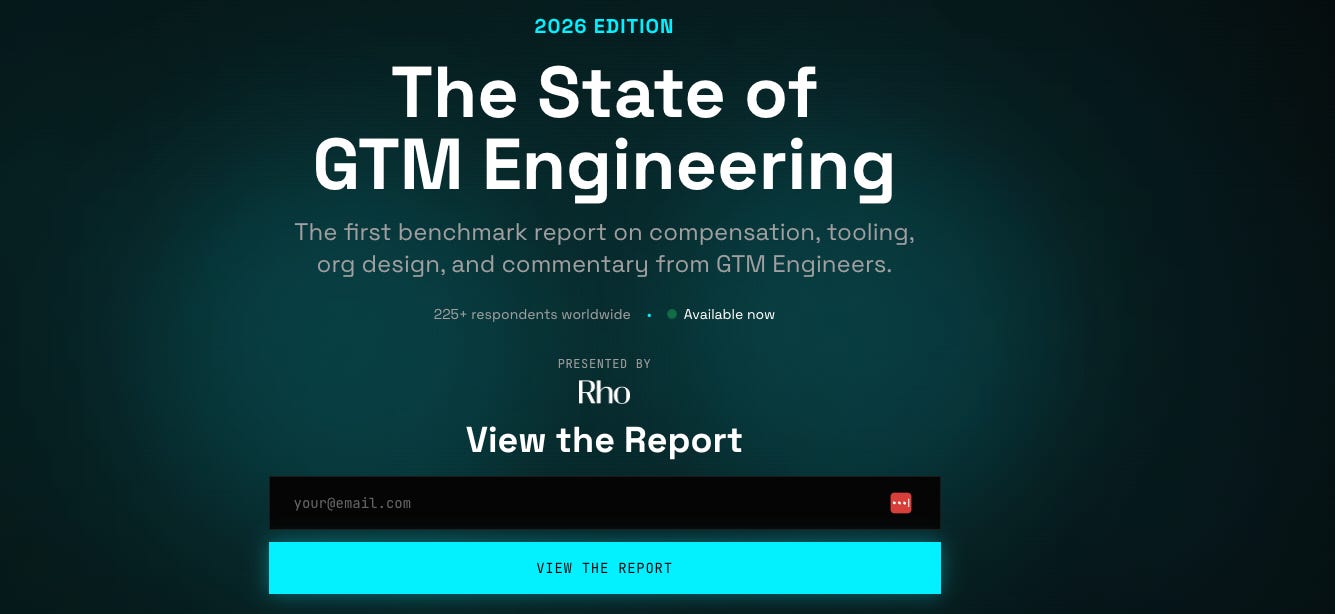
If you want to go deeper, the guys at GTM Cafe just put out the first benchmark report on GTM engineering, covering compensation, tooling, org design, and commentary from 225+ GTM engineers worldwide. It’s a really good read, and probably the best attempt yet at demystifying what this role actually looks like across companies.
Definitely worth checking out.
yes, so founders need to figure out if they actually need net-new demand or velocity on demand they already have.
I think on the RevOps side of the house you will start to see those skillets as an expectation for their specific function!
Ex: for an AE you’ll be expected to know how to build your own agents to help with prospecting, call prep, forecasting, etc