
As a marketer, I’ve always believed in the importance of feedback loops. That’s where I’d often audit what’s working, what’s not working as planned, and then go deeper on the things that are really working to see if there are opportunities to squeeze more out of them.
Recently I ran two audits back to back on my outbound, and the combination opened up a lateral expansion opportunity that’s giving me ~30-50% uplift in new prospects entering my campaigns.
Audit #1: what our booked meetings actually look like
I built a small n8n workflow connected to our company Slack and pulled every meeting our BDRs and I had booked from Jan 2026 to April 2026. Then I extracted the full list of job titles of the people we’d actually converted.
I’d done this exercise once before in Jan when I first set up my targeting. The new list looked different. Three different clusters of titles were showing up that weren’t in my outbound ICP:
Video production roles: producers, multimedia leads, content creators
Marketing-adjacent roles: community, brand, partnerships, growth ICs
Learning & development roles: instructional designers, learning managers, training leads
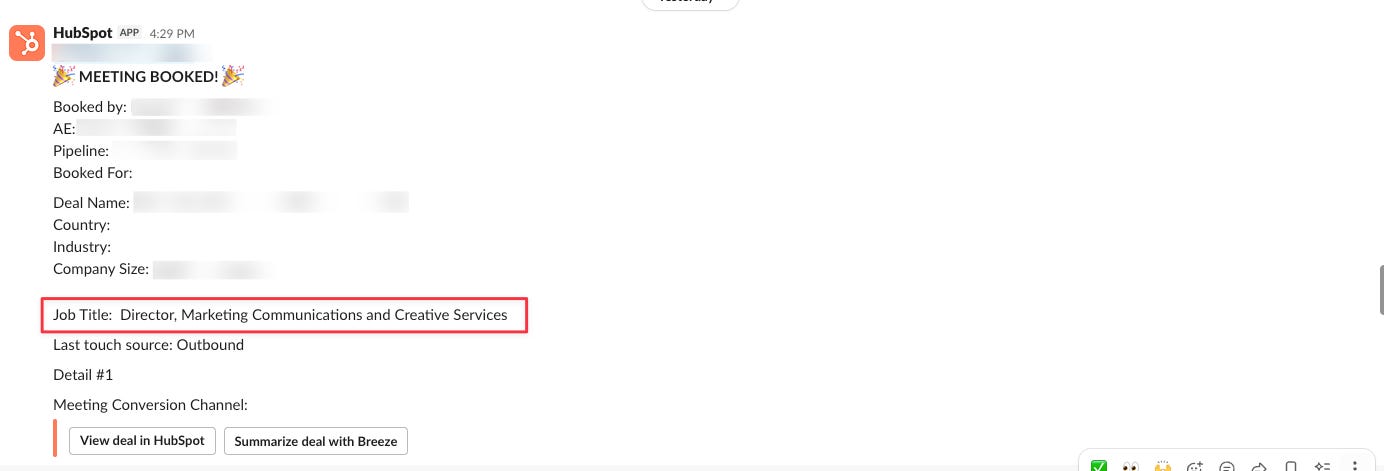
These weren’t edge cases as they a recurring share of meetings we’d already booked. Our actual buyers were broader than my targeting.
Audit #2: what’s leaking out of my Clay flow
I picked my single best-performing signal and traced what was happening to companies that matched it inside my Clay workflow.
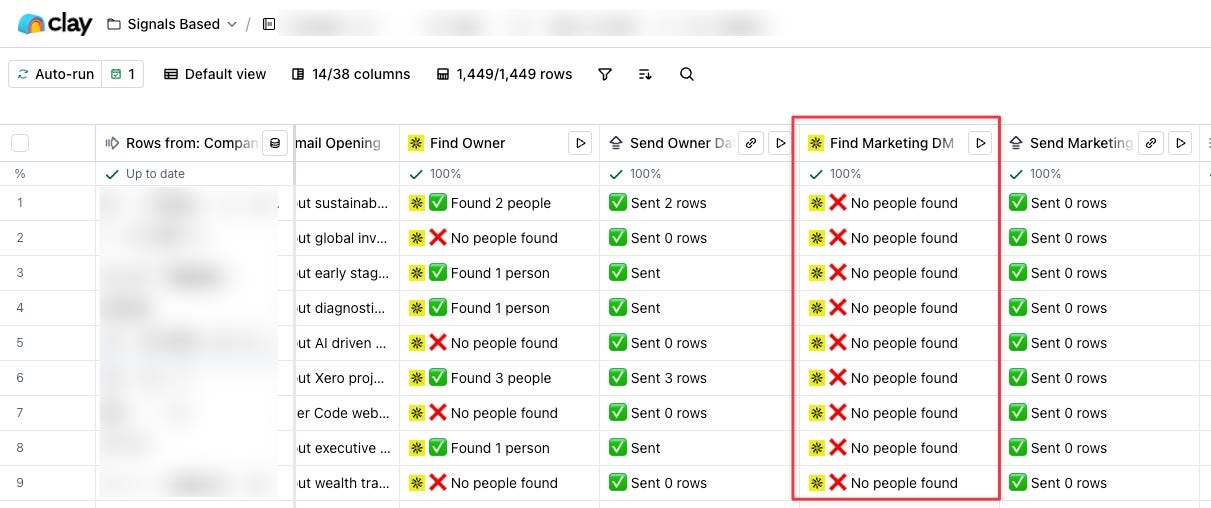
A meaningful number of them (which are companies that fired the signal) were being silently dropped because Apollo’s keyword-based people-finder couldn’t surface a “marketing decision-maker.”
The workflow just couldn’t find anyone, so no outbound emails were went out.
The big opportunity
I had 2 learnings from my audits. My targeting was too narrow on titles (Audit #1) and too keyword-dependent on Apollo (Audit #2).
Opportunity #1: Lateral expansion into non-marketing titles.
The booked-meeting data from Audit #1 showed our actual buyers often sit outside the marketing department entirely.
They’re producers, comms leads, training directors, growth ICs. If I’m only targeting CMOs and Heads of Marketing, I’m missing out a whole set of titles that have already converted for us. The BDR list becomes the source of truth for what to target laterally.
Opportunity #2: Smaller companies where the "non-decision-maker" is actually the decision-maker.
In a lot of the companies that fire my signal, there’s no CMO or Head of Marketing in the org chart at all. My outbound flow was treating that as a dead end. But that’s usually not what’s going on. What it really means is that the senior content marketing manager, or the producer, or the L&D lead, is the decision-maker by default. There’s no one above them.
This is especially true for smaller companies. They get missed out by everyone running keyword-based searches for CMO-level titles. But if you go one level down the hierarchy, your decision-maker is just the more junior person. Same buying power, with just a different title.
This is where the bigger unlock is. Every outbound team in the world is trying to send cold emails for CMOs and Heads of Marketing. Their inbox is probably the most crowded one on the internet. The titles uncovered by these two opportunities are not.
Meaning: there’s a real opportunity for lateral expansion within companies that fire the same signal.
The workflow
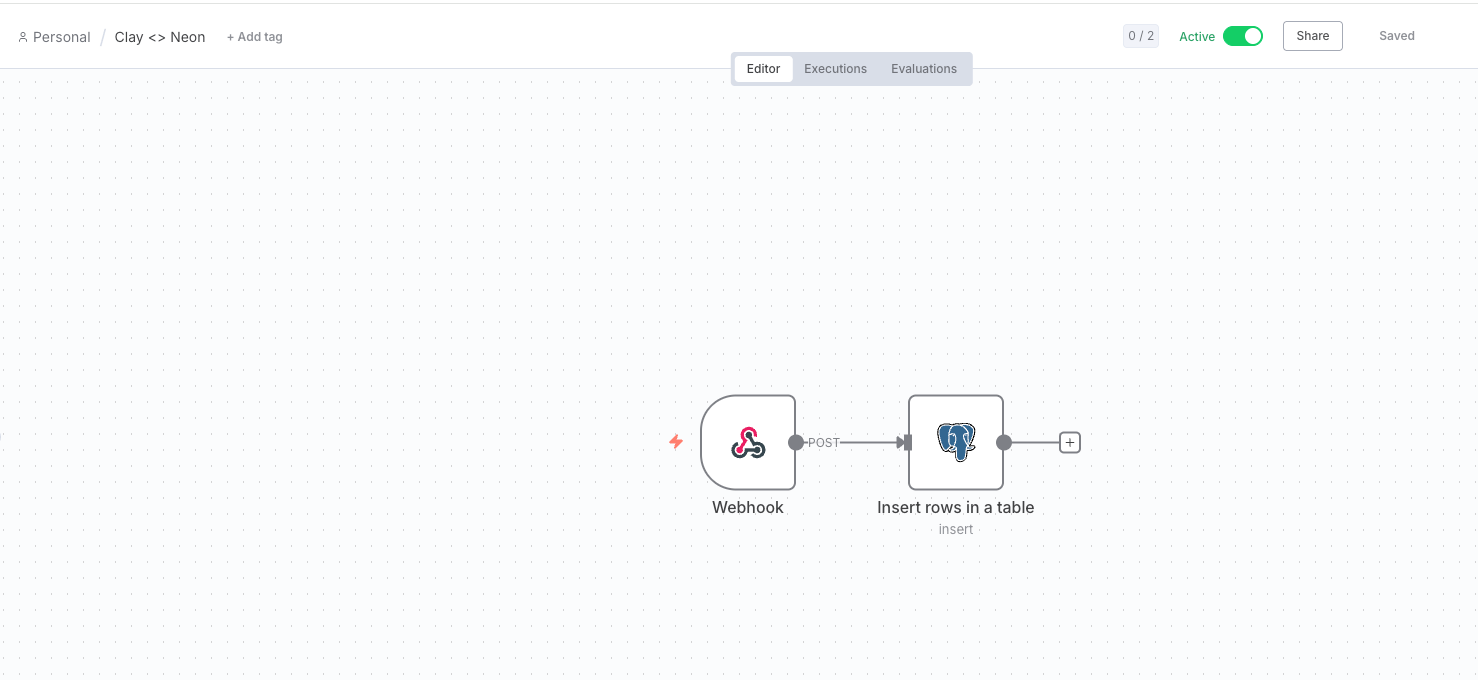
Clay → n8n → Neon → Claude → Neon → Clay (for deterministic CRM writes) → Outreach Sequencer
Step by step:
Feed Claude the whole list of booked-meeting job titles and ask it to summarize by department. This becomes the lateral ICP.
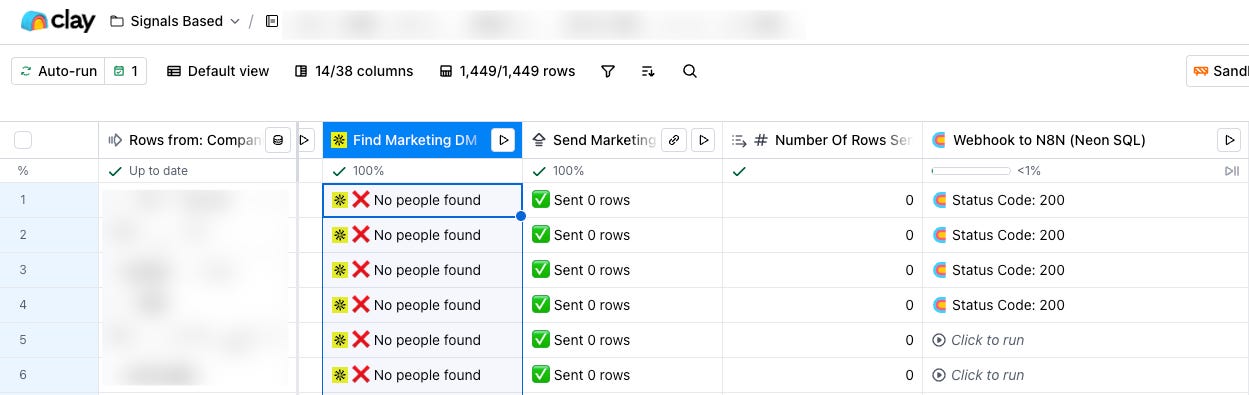
In Clay, identify companies that fire the signal but have zero marketing decision-makers. These are the lateral expansion candidates.
Push each candidate into a Neon SQL table via n8n. Clay can’t talk to Postgres directly, so n8n sits in the middle as a webhook → Postgres node. I am already familiar with n8n, so it was the obvious choice.
Claude reads the queued companies and pulls the full Apollo employee list for each company.
Expansion #1: lateral departments. Run the full list through the lateral ICP filter from Audit #1. Keep video/creative, content/events, and L&D titles. Drop sales-beneficiary and customer-success roles. Top two most senior per lens, with a bias toward removing in any ambiguous case.
Expansion #2: most senior marketing role. For companies with no CMO or Head of Marketing, find the most senior marketing person in the roster (senior content marketing manager, marketing manager, growth lead, etc.). In smaller companies, this person will be the decision-maker by default.
The surviving contacts get written into a second Neon table, then pushed back into Clay with the original signal context (the cold email opener, the HubSpot company ID) joined back on domain. The outreach sequencer takes over from there.
The good thing is that getting the full list of employees within Apollo is free. The search itself doesn’t burn enrichment credits, so the loop is cheap to run weekly across hundreds of companies.
Actual results
With a sample run of nearly 100 companies which the the deterministic clay flow had previously dropped:
The full employee list scan pulled around 3,000 employees in under a minute
After the ICP filter, the pipeline returned just over 100 viable contacts across roughly 58% of the list
Nearly all were net-new, not already in our CRM
Strategy
Just wanted to share some of the thought process behind all this. These are the principles I keep coming back to when I’m building or auditing workflows:
1. Use customer data to guide your marketing efforts. The booked-meeting titles from Slack weren’t a guess but they were proof of what’s already converting. Whenever you’re setting up targeting, filters, or ICPs, ground them in your own customer data first.
2. When something is working, ask how to get more out of that signal. My best-performing signal was the obvious place to look for leaks. If a signal is converting, every company you drop from it is a real opportunity that was left out. The leverage is in going deeper on what’s already working and not chasing new signals.
3. Plan for regular feedback loops. I run a booked-meeting audit every quarter. The list always looks materially different from the last one, which is exactly the point. Our ICP shifts over time as the product, market, and buyers evolve, and the quarterly cadence makes sure my targeting reflects who our buyers are now, not who they were six months ago.